The XRP Ledger (XRPL) is a decentralized, public blockchain led by a global community of businesses and developers looking to solve problems and create value. Proven reliable over more than a decade of error-free functioning, the XRPL offers streamlined development, low transaction costs, high performance, and sustainability. It’s fast, energy-efficient, and purpose-built for financial applications such as cross-border payments, tokenization, and decentralized trading.
The XRPL’s strengths set the stage for what’s next: unlocking open, flexible, and powerful public data access.
If you’re a developer building on the XRPL, you’ve likely wrestled with technical APIs or had to stand up custom infrastructure just to analyze trends. If you’re a trader, researcher, or investor, you’ve probably noticed that major analytics platforms have yet to fully integrate the XRPL’s data for easy access and analysis. With momentum building around new protocols and sidechains, the XRPL is stepping into a new era of accessible, structured data tooling.
We’re excited to announce a major analytics integration for the XRPL, made possible through a direct partnership between Baselight, the permissionless data marketplace and analytics hub; XRPScan, the most trusted data provider and explorer in the XRPL ecosystem; and XRPL Commons, a leading community organization dedicated to supporting builders and advancing transparency across the ledger.
XRPL data is now indexed, queryable, and remixable alongside billions of other data points on Baselight!
Unlocking New Possibilities with XRPL Data
The XRPL ecosystem continues to evolve rapidly, with recent protocol enhancements like native AMMS, decentralized identity, and greater support for native stablecoins (like Ripple USD) broadening its technical capabilities and expanding use cases. As adoption scales and real-world integrations deepen, the need for open, structured, and scalable access to ledger data has become increasingly urgent.
That’s where this new integration with Baselight comes in.
By indexing, structuring, and surfacing XRPL data on Baselight in a fully queryable, SQL-native format, developers, researchers, and institutions now have instant access to critical onchain data, all without the friction of running their own infrastructure or parsing opaque APIs.
Even more transformative is the ability to join XRPL data with thousands of other datasets already available on Baselight, including activity on chains like Ethereum, Base, BNB Chain (and many others), macroeconomic indicators, liquidity metrics, and more. This opens the door to novel cross-chain research, compliance automation, and real-time dashboards built on XRPL insights.
This effort complements the ongoing work contributed by community hubs like XRPL Commons, who continue to push for transparent, accessible infrastructure that empowers builders and reinforces the XRPL as a leading protocol in the decentralized ecosystem.

XRP locked in AMM pools has steadily grown alongside cumulative transaction volume, signaling deeper liquidity and rising participation over time.
View the chart/query here.
Indexing the XRPL with XRPScan
At the heart of this integration is XRPScan, the long-established block explorer and analytics provider that has served the XRPL community since 2018. Their infrastructure acts as the primary source of truth for thousands of tokens, validator records, and ecosystem signals.
Through direct collaboration, XRPScan’s historical and real-time datasets are now fully normalized, flattened, and optimized for public analytics on Baselight. The result: a high-quality, composable data experience covering a wide range of XRPL dimensions.
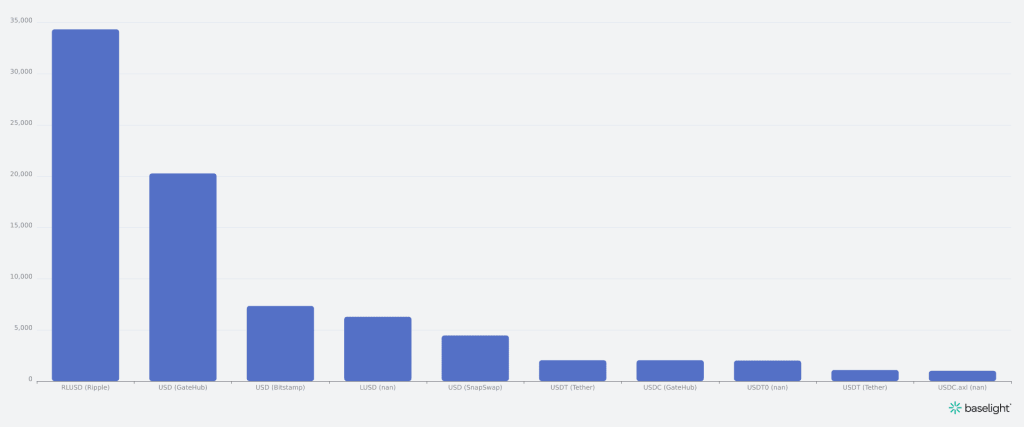
RLUSD leads all XRPL-issued stablecoins by number of holders, with over 50% market share among tokens with significant adoption.
View the chart/query here.
What’s Included
The XRPL dataset provides comprehensive data from the XRPL, one of the most efficient and sustainable blockchain networks for payments and tokenization. We are continuously working with the XRPScan team to add more and more XRPL structured data to Baselight. To start, this integration captures rich data across eight key dimensions of the XRPL ecosystem:
- Automated Market Makers (AMMs): Complete liquidity pool data including asset pairs, LP tokens, trading fees, auction slots, and governance voting—everything you need to study decentralized trading mechanics on XRPL.
- Tokens and Currencies: Metadata for all issued tokens beyond native XRP, with details on supply, trustlines, issuers, holder counts, and trading volumes—structured for compliance use cases and token ecosystem mapping.
- Network Metrics: Daily aggregate stats on ledger performance, transaction types and outcomes, account creation trends, and other usage indicators—ideal for macro-level network health analysis.
- Network Nodes: Infrastructure-level data on peer nodes, software versions, connectivity patterns, and uptime—critical for understanding topology and infrastructure evolution.
- Validators: Deep information on validator identities, consensus voting records, performance stats, and operational behavior—essential for security audits and decentralization studies.
- Child Accounts: Information about accounts created through Payment transactions, including parent-child relationships, initial funding amounts, and creation timestamps for analyzing account growth patterns.
- Well-Known Account Names: Registry of verified and notable accounts with their associated metadata, including exchanges, services, and organizations, useful for identity verification and compliance monitoring.
- Account Balances: Current XRP balance information across accounts, providing insights into wealth distribution, liquidity patterns, and network economics at the account level.
All nested JSON structures are transformed into clean, relational tables, making the entire dataset easy to query and join with other data. If you’re building on the XRPL, or part of the XRP Army and have data you want to see on Baselight, please reach out at hello@baselight.ai.
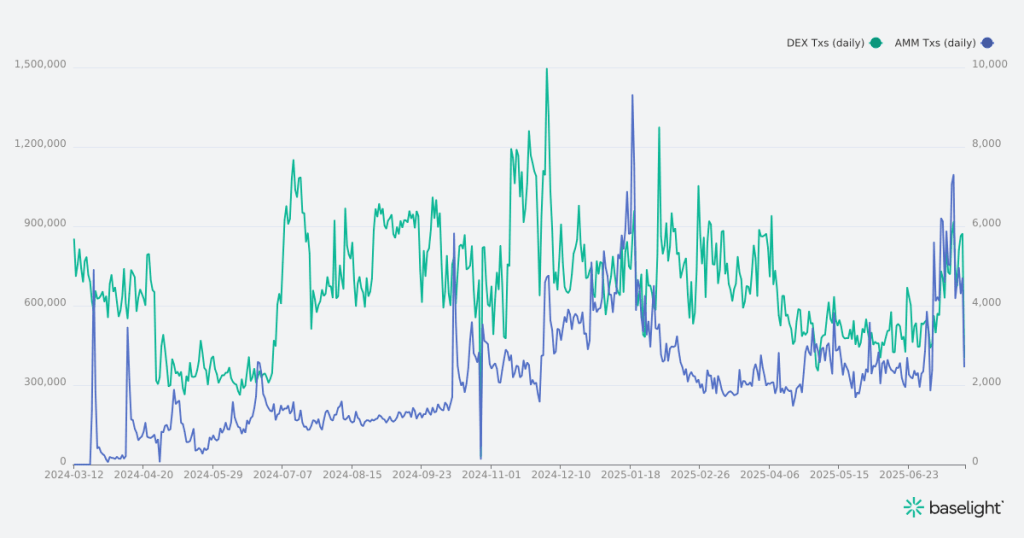
Since launching in March 2024, XRPL’s AMM transaction activity has steadily grown, with daily usage now regularly rivaling traditional DEX operations.
View the chart/query here.
What You Can Do with XRPL Data on Baselight
With these datasets now accessible on Baselight, builders, analysts, governance participants, and researchers in the XRPL ecosystem have a powerful new suite of tools at their fingertips. Here’s what becomes possible right away:
- Run an XRPL AMM query in seconds: Explore near real-time and historical data from XRPL’s native AMM pools. Track liquidity volumes, LP token balances, and trading activity.
- Monitor Validator Health and Activity: Use Baselight’s charting tools to monitor validator uptime, consensus activity, and voting behavior. Ideal for wallet providers, governance researchers, and anyone tracking XRPL network health.
- Search and analyze verified accounts and tokens: Access structured datasets on well-known XRPL accounts and issued tokens. Analyze trustlines, supply changes, exchange wallet behavior, and token issuer activity for compliance or transparency.
- Combine the XRPL with other ecosystems: Join XRPL data with Ethereum DEX activity, macroeconomic indicators from Base, or NFT issuance from other chains like Optimism and BNB Chain to power multi-network dashboards or comparative research.
- Fork a query and start your own insight: Browse Baselight’s catalog of shared XRPL queries, fork one the fits your needs, and customize it with your own filters or joins.
These workflows are optimized for both technical and non-technical users alike, making XRPL’s depth of data available to anyone with curiosity and a browser.

Payments and OfferCreate transactions dominate recent XRPL activity, together accounting for the vast majority of onchain interactions over the past week.
View the chart/query here.
XRPL in a Broader Data Universe
The XRPL now lives alongside more than 75 billion indexed data points on Baselight, spanning 278,000+ tables and 51,000+ datasets. This ecosystem enables collaboration between builders across chains, financial analysts, DAO researchers, and academics.
By being part of this ecosystem, the XRPL is not just more visible, it’s more integrated:
- Developers can build wallets or protocols directly on data-backed insights
- Researchers gain visibility into dynamic ecosystem activity without relying on outdated snapshots
- Community leaders can monitor decentralization, fairness, and protocol health publicly
And with XRPL Commons continuing to advocate for open access, composability, and public goods infrastructure, the momentum behind analytics-driven innovation in XRPL is only growing.

Account creation on XRPL surged during key protocol milestones, with steady cumulative growth pushing the network past 7 million total accounts.
View the chart/query here.
Why Baselight?
Baselight is a permissionless analytics platform purpose-built for structured data. It makes it easy to publish, query, remix, and analyze data from any domain, including crypto, finance, research, and infrastructure. Imagine SQL combined with GitHub and decentralized data sharing.
For the XRPL community it brings a new set of capabilities:
- Run cross-chain analysis: Compare cross-chain data, like XRPL AMM volumes with those on Ethereum or Base. Join token metadata across ecosystems. Compare validator behavior across L1s.
- Explore dashboards and custom visualizations: Use Baselight’s in-browser SQL editor and charting tools to create dashboards, share insights, and monitor protocol performance.
- Build data-driven products: Power wallets, compliance tools, research workflows, and AI agents, all with open, transparent access to clean, indexed XRPL data.
- Tap into a broader data universe: The XRPL datasets are just one part of a catalog that includes over 75 billion rows of data, 278,000+ tables, and 51,000+ datasets.
And because Baselight is SQL-native and open by design, there’s no lock-in. Anyone can fork a dataset, remix a query, or publish their own analysis on top of XRPL data.
Built by and for the XRPL Ecosystem
This integration is made possible by a collaboration between three key players:
- XRPScan: the leading data and indexing service for XRPL
- Baselight: a permissionless analytics and data collaboration engine
- XRPL Commons: a community-driven innovation hub advocating for open, accessible tooling and infrastructure across the XRPL ecosystem
Their combined efforts reflect a shared commitment to unlocking better infrastructure, open analytics, and long-term ecosystem sustainability for all XRPL participants.
XRPScan is one of the leading block explorers and analytics providers for the XRP Ledger. Since 2018, they’ve served as the go-to source for ledger data, validator insights, account lookups, and market activity tracking. Their infrastructure is trusted by dozens of exchanges, wallets, tax providers, and institutional teams for its reliability and depth.
More than just a block explorer, XRPScan offers advanced search tools, powerful APIs, and a deep commitment to transparency in the XRPL ecosystem. Their collaboration with Baselight marks a major step forward in making XRPL data accessible to all.
Start Exploring
XRPL data is live on Baselight, and this is just the beginning!
Whether you’re analyzing validator voting behavior, building a DeFi dashboard, mapping token movements, or comparing AMM liquidity across chains, you now have the tools to do it, all in one place, and all seamlessly accessible.
From builders and researchers to curious community members, anyone can now explore and analyze the XRP Ledger with powerful, easy-to-use tools.
👉 Start querying XRPL data on Baselight
We’re excited to see what the community builds next.